Gaza's ceasefire was meant to be a bridge to peace. It is becoming a border
The man the United States installed to oversee Gaza's ceasefire used his first public briefing to warn that it is failing. Nikolay Mladenov, who runs the board charged with implementing the deal, stood in Jerusalem this week and said the stalemate now risks cementing the territory's permanent division, leaving two million people without a viable future while Israel's hold over more than half of Gaza hardens; a status quo, he said, should not be an option for anyone. When the official appointed to deliver a peace spends his debut warning that it is curdling into partition, the ceasefire has already failed at the one thing a ceasefire is for.
Consider what the agreement actually became. When the truce took effect last October, Israeli forces pulled back to a demarcation its planners called the yellow line, retaining control of roughly half the strip, and the later phases — the disarmament of armed groups, an international stabilisation force, reconstruction, and a full Israeli withdrawal — were meant to follow, yet seven months on, none of it has advanced. The ceasefire that was supposed to freeze the lines of battle has instead frozen only the half of the bargain that suits the stronger party.
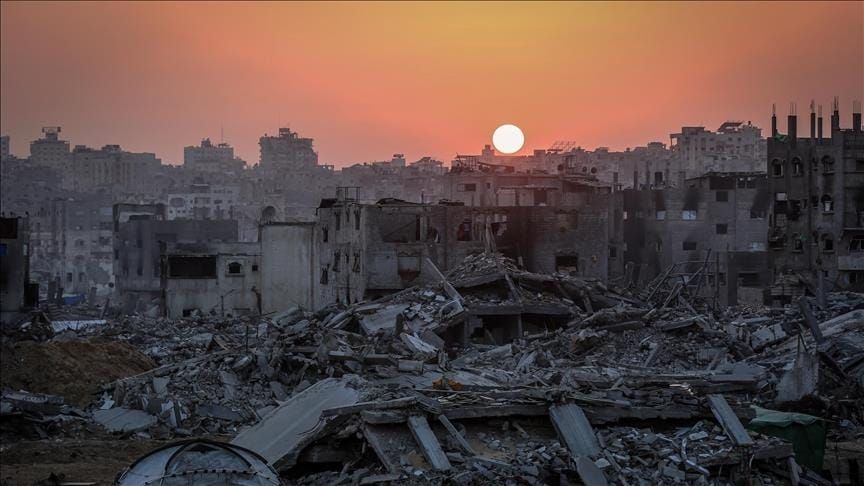
Meanwhile the line itself has begun to walk. The yellow demarcation is creeping westward, toward the Mediterranean, cramming the population into a shrinking strip of land, and by this spring Israel had brought close to two-thirds of Gaza under its control, expanding its footprint by around a tenth since the deal was signed. The line is unilateral, in places unmarked, and lethal to approach; Palestinians have been shot for crossing it or merely lingering near it. A boundary drawn by one army, enforced by its fire, and quietly advanced month by month is not a ceasefire provision. It is an annexation with a cartographer.
And the word "ceasefire" is bearing an extraordinary weight. By the accounting of monitors in Gaza, the first half-year of the truce brought more than two thousand Israeli violations, over a thousand airstrikes and shelling incidents, and hundreds of shootings at civilians; the dead since October now number well over nine hundred. That is not a pause in a war. It is a war continued at lower volume, under a label that launders it for the headlines, and the label is the point, because "ceasefire" is the word that persuades the world it can look away.
Here is the part too easily mistaken for failure. The freezing of the next phase is not a delay; it is, increasingly, the outcome. A first phase left permanently in place hands Israel two-thirds of Gaza with no obligation ever to leave, and Israeli leaders have stopped troubling to hide that this suits them, gesturing openly at annexation and the thinning of the population. The transition that never transitions is not a stalled journey. It is the destination, dressed as a waystation, and the longer it endures the more it sets.
None of this could proceed so quietly without the cover of a louder war. While the world's attention is fixed on Iran and Lebanon, Gaza is being partitioned in the margins, and the guarantor that might object has chosen not to. Pressed on Israel's violations, the United States deflected the question onto Hamas and declined to enforce the plan that carries its own president's name. The architecture built to deliver a Palestinian future is instead supplying the paperwork for its foreclosure, and the silence of the powerful is not neutrality. It is permission.
So Mladenov is right that a permanent status quo should be unacceptable, and late to notice that it is precisely what is being built, deliberately, while no one with leverage raises a hand. A ceasefire is meant to be a bridge from war to peace. This one is being poured, slowly and on purpose, into a border. The danger he warned of from a Jerusalem podium is not somewhere ahead on the road. It is already here, and it is hardening.