Armenia, Azerbaijan and the peace that lives in a photograph
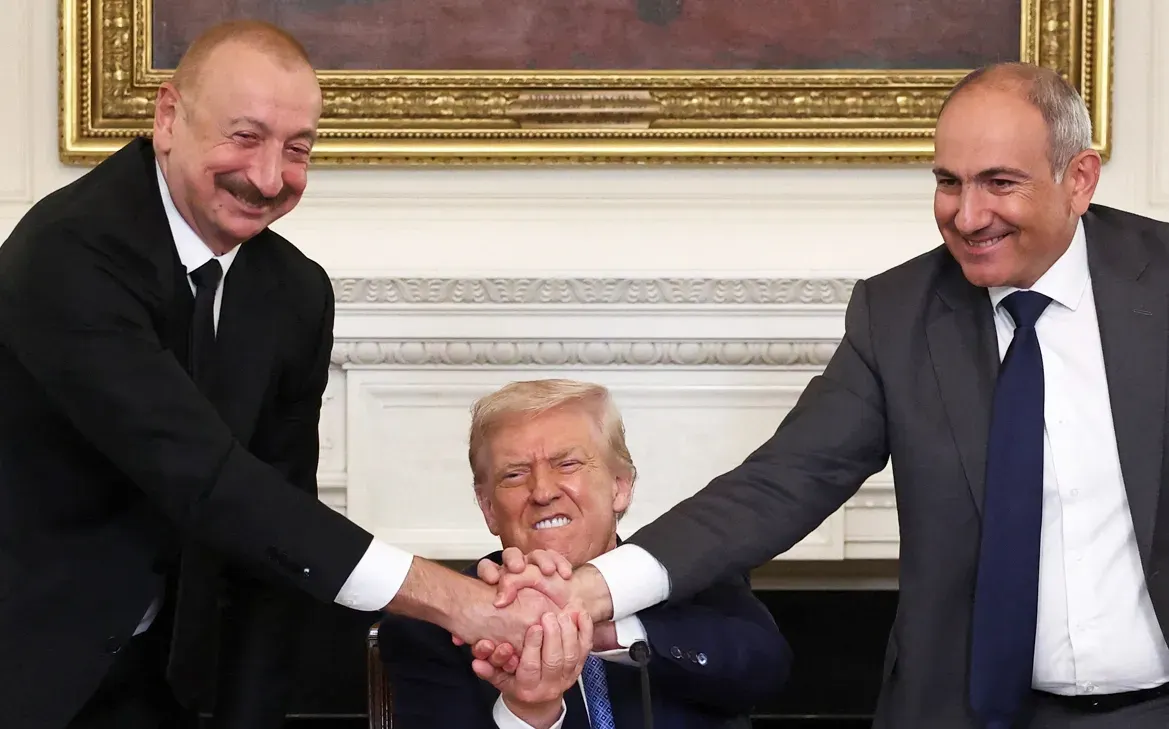
Five months on, the most concrete thing the Armenian-Azerbaijani peace has produced is still a photograph. You remember it: the American president centred in the frame at the White House, the hands of Nikol Pashinyan and Ilham Aliyev folded into his, two men who spent three decades at war arranged into a tableau of friendship. The picture went around the world in August. The treaty it was meant to announce did not.
This is the awkward fact the new year has dragged back into the light. What the two leaders actually put their names to last summer was not a peace treaty at all. In its dissection of the deal, Just Security called the Washington document what it is, a joint declaration, a political promise to keep working toward an agreement whose text had been finalised months earlier and then left to gather dust. The ceremony was real. The signature was not on the thing that mattered.
Behind that lies a single, stubborn condition. Baku will not ratify the treaty until Yerevan rewrites its constitution to remove what Azerbaijan reads as a buried claim to its territory. RAND, in a cool-headed assessment this week, notes that the Armenian process runs through a referendum unlikely before 2027, which leaves the central promise of the whole enterprise hostage to a vote two years out, in a country where Pashinyan's footing is anything but firm. A peace that depends on a constitutional amendment is not yet a peace. It is an intention with a long fuse.
At the heart of the bargain sits a road. RAND describes the planned transit route across Armenia's southern Syunik province, linking the bulk of Azerbaijan to its marooned exclave of Nakhichevan and, by design, bypassing both Russia and Iran. Someone in Washington thought to christen it the Trump Route for International Peace and Prosperity. The branding is comic; the geography is not. Reporting at the time of the signing made clear the corridor would hand the United States development rights over a strip of land that Russia, under the 2020 ceasefire, was meant to police. In one move the project writes Moscow out of a region it has dominated for two centuries and presses on a frontier Tehran treats as a red line. Neither capital has swallowed that in silence, and neither is a spent force on Armenia's doorstep.
Strip away the ceremony and what remains is, in large part, a commercial proposition. The centrepiece of the declaration, as Just Security pointed out, is an investment package, with both states signing parallel economic agreements with Washington the same day. This is peacemaking in the present American idiom: resources and real estate offered as lubricant and reward at once. It can work. Transactions align interests, and interests sometimes hold where goodwill collapses. Yet a settlement built on the promise of money carries the flaw of its own design. When the money moves, or the attention does, the peace tends to follow.
Attention is the weak joint in the whole structure. There are no peacekeepers here, no treaty guarantees, no enforcement beyond the interest of the man who arranged the cameras. The Hudson Institute, making the case that 2026 could still be the year peace takes hold, concedes in the same breath that it will demand sustained American pressure on both sides; Carnegie is blunter, naming early 2026 the critical window before the moment shuts. Read plainly, both say the same uncomfortable thing. The deal will last precisely as long as Washington keeps caring, and Washington's gaze, as Ukraine and the Middle East have shown all year, does not rest on the South Caucasus for long.
It is worth naming what this peace would, and would not, undo. The war these states fought was not an abstraction. When Azerbaijan retook Nagorno-Karabakh in 2023, well over a hundred thousand Armenians fled the enclave within days, a population emptied almost overnight, and nothing signed in Washington brings them home. A treaty would fix a border, open a road, perhaps even thaw Armenia's frozen frontier with Turkey. It would not be reconciliation. It would be the absence of war, which is far from nothing, but is also not what the photograph seemed to promise.
So the year opens with a question, not an achievement. The handshake was the easy part; it always is. What 2026 will decide is whether anyone is prepared to sign the document the photograph pretended to celebrate, or whether the most successful image of the Caucasus peace proves to be the peace itself: an ending staged for the cameras and never quite delivered.